The 2025 SCORE Baja 1000 took place on the Baja California Peninsula in Mexico and marked the 58th edition of the legendary race. This year, the event followed a loop format starting and finishing in Ensenada, located in the northern part of the peninsula. The course drew attention for several reasons: shortened and rerouted sections due to rainfall, and the revival of the iconic “Wash” section. Top teams and individual racers from around the world battled across categories, captivating spectators with their endurance and skill in one of the most unforgiving environments on Earth.
In many ways, the 2025 Baja 1000 proved to be a particularly diverse and dynamic event.
Looking at the numbers, the four-wheel category saw 168 entries in 2025, down from 183 in 2024. Of those, 94 vehicles finished within the 36-hour time limit, resulting in a 55% completion rate (compared to 61% in 2024 with 112 finishers). The more physically demanding two-wheel category had 67 entries in 2025 (down from 101 in 2024), with 37 completing the race (55% finish rate compared to 64% the previous year). In total, about 250 vehicles from 36 U.S. states and 21 countries took part in the grueling competition.
The Baja 1000 typically alternates between two course layouts: the Peninsula or Point-to-Point format, and the Loop format. The former has a separate start and finish point traversing the peninsula lengthwise, while the latter begins and ends in the same location, circling a route that returns to the starting point.
For 2025, the race mirrored the 2024 edition, starting from Ensenada, heading south along the western coast of the peninsula, turning near Chapala, and returning north on the eastern side back to Ensenada. The total distance was 864.13 miles (approx. 1,390.68 km), similar to the previous year. The Sportsman class took a shortened version of the course, measuring 731.61 miles (approx. 1,177.41 km).
To avoid overlap between two- and four-wheel vehicles, the motorcycles departed first at midnight on Friday, November 14 (local time), while the four-wheel class—including the marquee Trophy Trucks—began racing at 9 a.m. later that morning. Any team that returned to Ensenada within the 36-hour time limit was classified as a finisher.
Though some sections include Speed Zones (public roads with speed restrictions), the majority of the racecourse comprises intensely rugged off-road terrain. After several Trophy Trucks have passed, the deepened ruts make the route especially difficult even for 4WD vehicles equipped with 37-inch off-road tires.
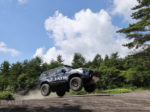
This year’s weather added further challenge: rain worsened the course conditions, and lower temperatures increased the physical toll. Many competing vehicles had no front windshields—leaving drivers exposed to dust in dry weather and drenched when it rained. Precise handling under such extreme conditions was critical.
Despite being held in Mexico, the Baja 1000 is not widely regarded as a domestic event. Baja California’s geographic separation from mainland Mexico by the Gulf of California makes it easier to access from the U.S. West Coast, and many Mexicans view it as an American motorsports event held on local soil.
Nonetheless, for residents of Baja California, the Baja 1000 has become a beloved annual festival. Although SCORE does not publish official attendance figures, some estimates suggest more than 750,000 spectators line the course. With no admission fee, many fans watch from the roadside, grilling food and cheering racers as they pass.
One highlight of the 2025 event was the return of the Ensenada Wash after six years. This dry riverbed section near the city offers excellent views from surrounding embankments and bridges. Measuring approximately 1.77 miles (2.85 km), it included jump features that launched Trophy Trucks into the air—eliciting roars from the crowd.
Japanese teams drew significant attention in 2025. TEAM JAOS entered the race for the fourth consecutive year, this time with the LEXUS GX550h TEAM JAOS 2025ver.—a rare hybrid vehicle in this harsh environment. The team successfully completed the race, proving the durability and capability of the GX550.
Notably, TEAM JAOS driver Tomonori Noto completed the entire course solo for the second straight year, again earning the coveted “Ironman” designation.
Veteran Japanese driver Ikuo Hanawa also competed, piloting a TOYOTA FORTUNER. Unfortunately, he did not finish within the time limit and was recorded as DNF (Did Not Finish).
Honda fielded two vehicles: a V6-powered Passport and an ATV, both entered under the HRC (Honda Racing Corporation) works team. Neither vehicle completed the course, further underscoring the Baja 1000’s brutal difficulty.
Among the dominant U.S. competitors, Ford stood out. As a key event sponsor, it entered four vehicles in the stock categories. Both the F-150 Raptor (Stock Full Size) and Bronco Raptor (Stock Mid-Size) claimed victory in their respective classes.
In terms of overall results, Christopher Polvoorde, driving for Ford/Mason Motorsports, won the four-wheel division with a time of 15:48:05.532. In the two-wheel division, Tyler Lynn topped the Pro Moto Unlimited class with a time of 17:55:30.008.
And as always, the perennial debate that inspired the Baja 1000 in the first place—Which is faster: two wheels or four?—was settled once again in favor of four wheels.
2